Why retinal and not retinol
The skin cannot use Vitamin A in the form it is in the bottle. It must first be converted into retinoic acid, and this conversion happens in steps: retinol becomes retinal, and retinal becomes retinoic acid. A product with retinol must therefore go through both steps. A product with retinal starts halfway down the chain.
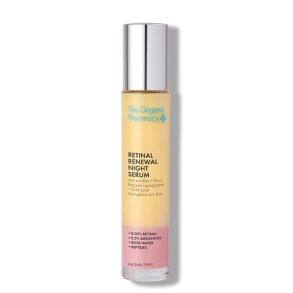
This is the reason why retinal products are usually formulated in significantly lower concentrations than retinol products. Here it is 0.03%. That number might look small next to the 0.3 or 0.5% you encounter on a retinol bottle - but the two numbers cannot be directly compared, precisely because the molecule is not at the same place in the chain.
The encapsulation is the second approach. Retinal is sensitive to light and oxygen, and it is also the type of molecule that causes the most disturbance in the skin if it gets it all at once. By encapsulating it, two things are achieved: it keeps better in the bottle, and it is gradually released into the skin instead of in one hit.
What else is in the bottle:
- Bakuchiol, 0.5%. A plant extract from Psoralea corylifolia, which in recent years has become a regular companion to Vitamin A in skincare. Here it is included as a complement to the retinal, not as a replacement for it.
- Peptides. Short chains of amino acids used in skincare products focusing on the firmness and elasticity of the skin's appearance.
- Rose water. The serum's water phase is built on rose water rather than regular water. This is also what you can smell when you open the bottle.
How to use it
- Cleanse your face and pat it dry.
- Take 2-3 drops in the palm of your hand and distribute them over your face and neck. Avoid the area right next to the eyes.
- Let it absorb for a minute, and apply your night cream on top.
- Use sunscreen in the morning. Vitamin A makes the skin more sensitive to the sun, and this also applies the day after.
Start slowly
If you are new to Vitamin A, start with two to three evenings a week for the first couple of weeks, and then increase if the skin responds well. Many experience a little dryness or flaking in the beginning - this is common and usually settles down. If the skin remains irritated, take a break for a few days and resume with longer intervals.
Do not use it on the same evening as acids (AHA/BHA) or other Vitamin A products, unless your skin therapist has advised otherwise.
What to expect along the way
For the first two weeks, you should probably not expect to see changes - you might even see a bit of the opposite of what you hoped for. A little dryness, maybe a bit of flaking around the nose and mouth. This is the skin getting used to the Vitamin A - and don't worry, it settles down on its own. At four to six weeks of use, visible things typically begin to happen. The surface becomes more even to look at, and makeup sits nicer because there are fewer uneven areas to put it on top of. After two to three months, the results will begin to be more prominent, and fine lines will appear less distinct. Unfortunately, skincare products with Vitamin A are not products you can evaluate after just one month.
Good to know
- The serum is not recommended during pregnancy and breastfeeding. This is the manufacturer's own recommendation, and it is worth following.
- The product contains perfume, including the declarable fragrance allergens citral, citronellol, cinnamal, eugenol, geraniol, limonene and linalool. If you are known to be sensitive to fragrances, try the product on a small area first.
- Store the bottle in a dry place and out of direct sunlight. Vitamin A is best kept in the dark.