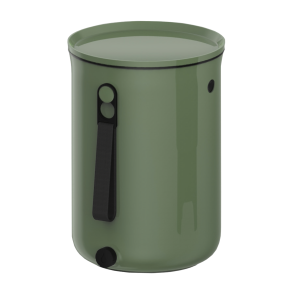
Bokashi compost bin - Khaki
BokashiBOK-76049
Bokashi compost bin
Right here, a beautiful design is combined with functionality in focus. Then you're lucky.
Bokashi 2.0 almost sounds like a very fast Japanese car - but is actually something as down-to-earth as a compost bin for your kitchen.
It's not Japanese either, the Bokashimethod originates from Korea, and is a pretty smart way to make your own free and natural fertiliser.
Bokashi is a special way of composting your bio-waste. Food waste and organic residues break down in the airtight bin in just 14 days using compost yeast, microorganisms and enzymes.
The organic waste actually goes through a fermentation - that is, a chemical fermentation process, and the method is fast and differs quite a lot from traditional ways of composting in large compost bins filled with air.
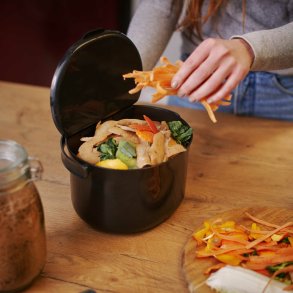
The food waste becomes nutrition that can be mixed with / added to soil and used in, for example, potted plants, pots and raised beds. The Bokashi liquid that is tapped from the bottom of the bucket is great as both fertilizer and drain cleaner.
With the Bokashi compost bin, you have the opportunity to recycle your organic waste from the kitchen and get rid of it in a natural, good and meaningful way. It's a pretty great invention, especially for people who live in an apartment or townhouse with a sparse garden. You can even take it into the garden.
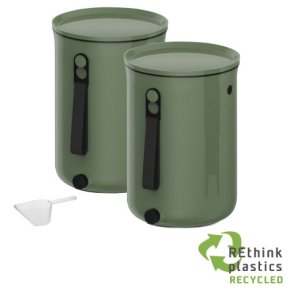
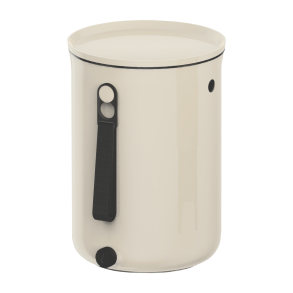
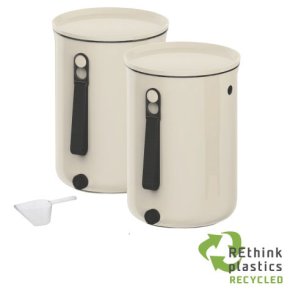
Bokashi 2.0 has a nice design and comes in three nice colours. This one is in the variant KHAKI GREEN
The compost binis produced in the EU from recycled plastic.
The bin is designed to be nice and smart in a kitchen. And to be able to stand on the kitchen table and be easy to handle.
It has a height of 34 cm and a diameter of 24 cm.
It weighs, without contents, 2.8 kg and holds 9.6 litres.
How to use your Bokashi Compost bin
It takes soil to make bokashi compost. It can be from a garden or from pots and raised beds. Bokashi must be mixed with soil to become compost.
- You first sprinkle compost yeast into your empty Bokashibucket, fill your food waste on top, sprinkle again and press the stamp down.
- Then you sprinkle compost yeast on top after each time you fill in (preferably only 1-2 times daily).
- The plunger creates a vacuum inside the bucket when you push it down onto the bucket.
- When you pull it up to add more food scraps, pull the handle, which releases the vacuum so the plate can be lifted out.
- When the bucket is full, the contents must fully ferment for 2 weeks before emptying.
- When you emptying the bucket, you can fold the round piston together so that it forms a semicircle and use it to scrape the bucket clean of food residues.
- Afterwards you can wash the individual parts in the dishwasher.
- The contents you empty out must be mixed with other soil to become compost. (Some make a small "soil factory" on the balcony or somewhere else).
- The drained liquid, which must be drained from the bottom of the bucket, can be used as fertilizer immediately if it is diluted 1:100.
You can buy compost yeast loose just here See the entire selection from Bokashi right here
92.80 €